
Seasonal care
Watering More During a Heatwave Can Kill Plants Faster Than the Heat Itself
In a heatwave, water pots, baskets and recent plantings first, deeply and early in the day, shade containers from the midday sun and mulch new plantings once watered. Leave established plants alone.
By the Aspen Rose team7 min read
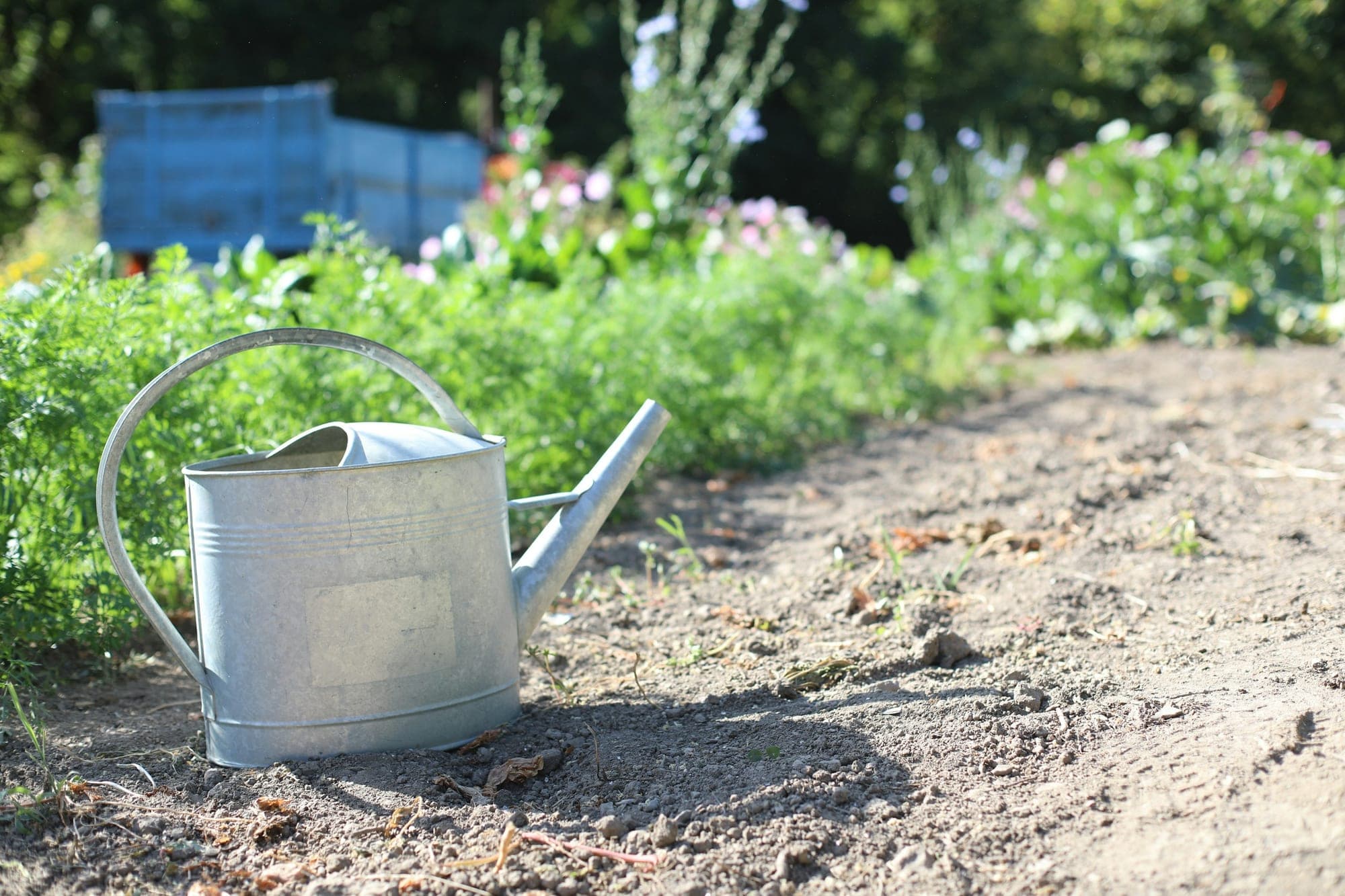
Most plants can survive a few hot days. The instinct to water everything, every evening, is usually the wrong one: it wastes water on established plants that do not need it and can still leave pots and new plantings thirsty, because what actually fails first are plants with small root systems, not established borders. Pots, baskets and anything recently planted need the attention. Established beds, in most cases, need you to leave them alone.
Spending water where it counts also matters when mains water is short, and the order below follows the RHS's priorities.
Which plants should you water first?
Water in this order, according to the RHS: hanging baskets, pots and window boxes, potted tomatoes and vegetables, then recently planted trees, shrubs and perennials.
The RHS says pots and hanging baskets dry out much faster than plants growing in the ground because they hold far less moisture.
Established borders are lower down the list, and for most gardens they should stay off it entirely. The RHS says plants that have been in for two to three years usually have well-developed roots, and that mature shrubs and established borders generally tolerate short dry spells. Its drought guide goes further and says established trees, shrubs and perennials chosen for their conditions usually need no summer watering at all. A wilting lawn or a few limp leaves on an established shrub is not an emergency; a wilting hanging basket is.
Two groups are easy to forget. The RHS says plants under tree canopies, walls or eaves may need extra water even after rain, because those spots stay dry. And if you want to keep flowers coming for bees, it suggests focusing on plants that are in flower or about to flower.
How should you water so it reaches the roots?
Water slowly and thoroughly, at the base, early in the morning. The RHS says evening is acceptable, but midday wastes water to evaporation.
The depth to aim for depends on what you are watering:
- Borders: moist about 15cm down.
- Newly planted trees and shrubs: moist to 20 to 30cm, where their roots are.
- Containers: fill to the rim, let it soak in, and repeat once. The RHS says to push a finger about a third of the way down the pot first, and water if it is dry there.
- A newly planted tree in dry weather: the RHS guide suggests about four to six 10-litre cans a week.
A watering can is the RHS's first choice because it is the most water-efficient method and gives you the most control, and sprinklers are among the least efficient. A small ring of soil built up around a plant, sometimes called a doughnut, holds the water over the roots while it soaks in, as RHS Wisley edibles expert Liz Mooney describes in her allotment diary.
Under Thames Water's 2026 hosepipe ban notice, for example, a watering can, stored rainwater and grey water are still allowed, and other suppliers' notices may differ. Our article on watering during a hosepipe ban covers the rules. The RHS says grey water should be used within about a day and kept off edible crops.
How do you shade and mulch plants in hot weather?
Move pots into a shadier spot and group them together. The RHS says grouping pots tightly creates a humid microclimate that reduces evaporation. A pot too heavy to move can be shielded from the midday sun with large garden prunings or taller potted plants. Stand pots on shallow saucers to hold a temporary water reserve, and put hanging baskets on the ground in shade.
Mulch helps, but timing matters. The RHS says to hold off mulching existing plants in a heatwave or drought, because a mulch laid now delays rain reaching the soil, and to wait for the autumn rains. Its exception is newly planted trees and shrubs: water them well first, then mulch. In general the RHS says to lay mulch over moist soil, at least 5cm deep and ideally 7.5cm, kept clear of the stems of trees and shrubs. It recommends mulching established beds in mid-to-late spring or in autumn, and says new plantings can be mulched at any time.
Not every plant wants it. The RHS says Mediterranean ground cover such as thyme may do better without mulch, which can hold moisture around its stems.
Is it heat stress, or something else?
Check the soil before you decide, because wilting has several causes.
| What you see | Likely cause | What the RHS says |
|---|---|---|
| Leaves drooping, especially first thing in the morning | Drought | Check the soil; the RHS wants borders moist at 15cm, and says to water pots when the compost is dry 2 to 3cm below the surface |
| Brown patches on the sun-facing side of the plant, shaded leaves fine | Sun and heat scorch | Most plants grow out of it; prune only in severe cases |
| Brown spots after watering in bright sun, mainly on hairy leaves | Droplets focusing sunlight | Smooth leaves are less at risk |
| Wilting that continues when the compost is damp | A root problem, such as vine weevil grubs in pots | Grubs feeding on roots make container plants wilt, mostly from September to March; tip the plant out and look for pale, C-shaped grubs |
Plants most at risk include newly planted climbers, shrubs and trees, Japanese maples, and camellia and honeysuckle after a heatwave, according to the RHS.
What should you not do in a heatwave?
Doing less is frequently the right call in a heatwave, which runs against most people's instinct to intervene. Hold off on these until the weather breaks.
- Do not feed. The RHS says plants are less able to take up nutrients without enough soil moisture, and that fertilisers encourage soft growth that dries out more easily.
- Do not rush to cut back scorched growth. The RHS says that in most cases the plant grows out of scorch, and that you may prune out the damage only in extreme situations. It also says to avoid heavy structural pruning during extreme heat.
- Do not plant anything new at the peak of a drought. The RHS says to hold off for as long as possible, until drought stress has eased. For a dry garden it suggests planting in March, as the soil warms, or in September, while it is still warm.
For next summer, planting for dry conditions pays off. The RHS suggests Mediterranean and silver-leaved plants, and Cyclamen hederifolium for dry shade under big trees. If you would like help choosing plants for a dry garden, we offer a free, no-obligation visit through our planting and design service, and the same applies to our garden maintenance service. The heatwave lawn guide covers the grass.
Sources
- RHS: Watering plants wisely
- RHS: How to water containers
- RHS: How to look after your garden on holiday
- RHS: Garden watering methods
- RHS: Drought-resistant gardening
- RHS: Weather damage
- RHS: Mulching
- RHS: Using grey water
- RHS: Vine weevil
- RHS: How to garden through a hosepipe ban
- RHS: Help bees and other pollinators in hot weather
This reflects what tends to work in most London and Hertfordshire gardens, not a guarantee for yours. How much water a bed needs depends on its soil, sun and the age of the planting, so treat this as a starting point rather than a fixed rule — get in touch if you'd like a proper assessment of your own garden.
Heatwave plant care questions
How do I revive a pot that has dried out completely?
The RHS suggests submerging the whole pot in a bucket of water for two hours, until bubbles stop rising.
Does misting leaves help in a heatwave?
The RHS holiday guide suggests misting stressed plants to cool them, but the real fix is water at the roots. Avoid misting in bright sun: the RHS notes droplets can burn leaves, hairy ones especially. Do not use it instead of watering.
Can I help bees in hot weather?
Yes. The RHS suggests a saucer with pebbles that small insects can land on to drink safely, topped up with fresh water and checked every day. It also suggests moving pots of flowering patio plants into the shade so they keep flowering.
Related services
- Garden MaintenanceRegular garden maintenance across London and Hertfordshire — mowing, pruning, weeding and seasonal care from an experienced team. Get a free quote.
- Planting & DesignPlanting and garden design across London and Hertfordshire — considered plant selection and layout planning from Aspen Rose. Get a free quote.
More from the blog
All articles →
Want a hand with your garden?
Tell us what you have in mind and we'll arrange a free, no-obligation visit and quote.
Free, no-obligation visit · Mon – Fri: 9:00 – 18:30