
Garden problems
Finding Japanese Knotweed Isn't the Crisis Estate Agents Make It Out to Be
Having Japanese knotweed in your garden is not an offence, but letting it spread is. Confirm what it is, leave it undisturbed and get a specialist, because cutting or digging it can make things worse.
By the Aspen Rose team7 min read
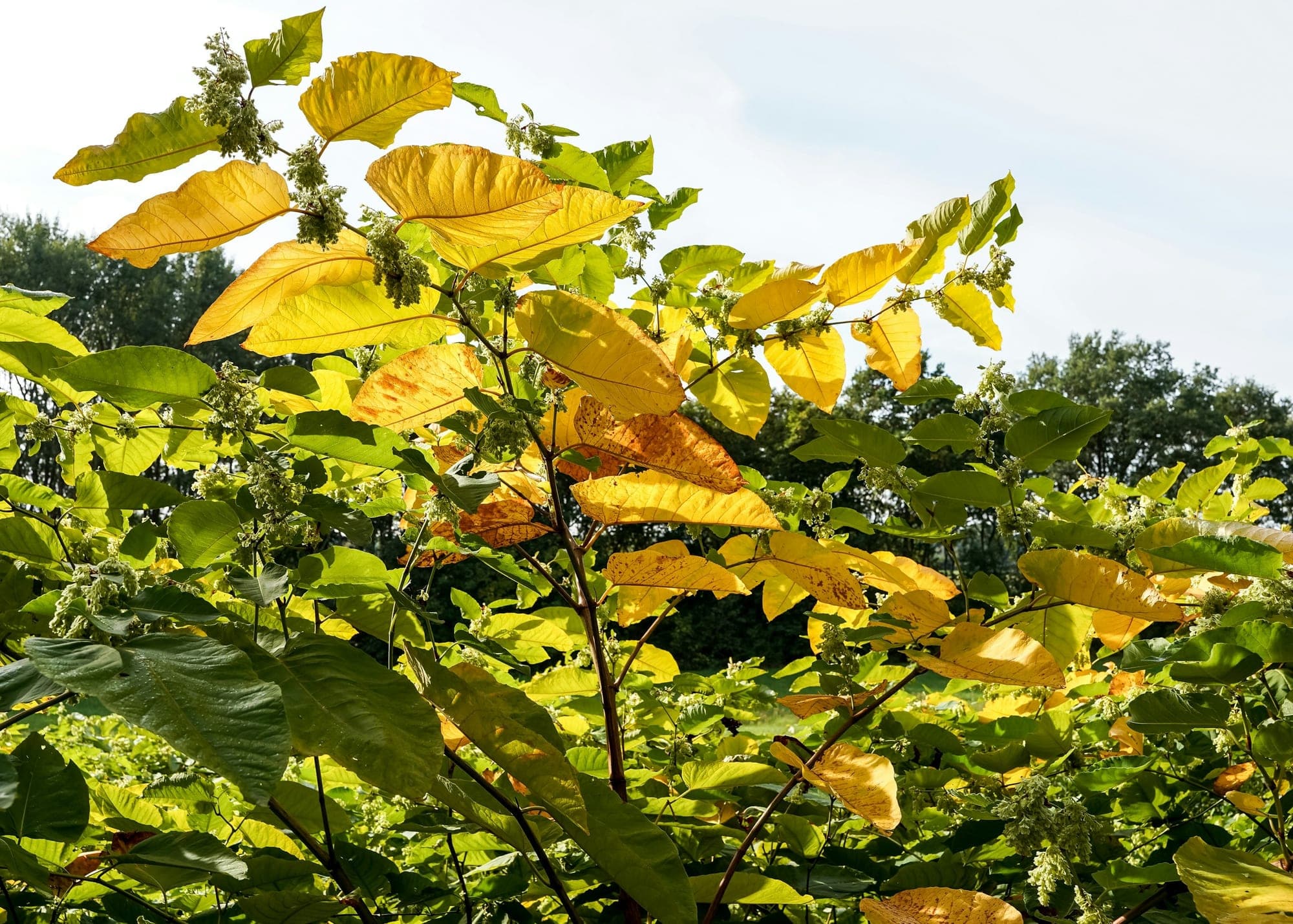
Knotweed has a reputation that badly outruns the legal reality, and almost every mistake people make with it comes from trying to get rid of it in a hurry.
How do you know it is Japanese knotweed?
Identify it properly before you do anything else, because the plant looks different in every season and misidentifying a look-alike is a common first mistake. The RHS describes the pattern:
- Spring: rounded pink buds at ground level, then reddish-purple shoots that grow quickly into bamboo-like canes with red speckles and hollow centres.
- Summer: stems usually reach about 2m and often arch at the top, with spade-shaped green leaves about 14cm long arranged in a zig-zag.
- Late summer to early autumn: small creamy-white flower clusters near the stem tips.
- Winter: stems die back to dry brown canes, while the roots and rhizomes stay alive and dormant underground.
The RHS lists several look-alikes worth ruling out first: Russian vine, Himalayan honeysuckle, fish mint, small-headed knotweed and a shorter variety of Japanese knotweed itself. GOV.UK says there are four invasive knotweed species in the UK, including giant and Bohemian knotweed, and points to the Non-native Species Secretariat for identification photos. If you are genuinely unsure, send photos to a specialist or the RHS, never a plant sample.
Is it illegal to have Japanese knotweed in your garden?
No, and this is worth saying clearly because the opposite belief does a lot of needless damage to sellers. GOV.UK says you must stop it spreading from your land and are not required to remove it unless it is causing a nuisance, though you can be prosecuted for causing it to spread into the wild. The RHS adds that planting it or allowing it to grow in the wild is an offence under the Wildlife and Countryside Act 1981, and that councils can act under the Anti-Social Behaviour, Crime and Policing Act 2014 where it has a persistent harmful effect on a neighbourhood.
The Environment Agency does not deal with individual garden cases either. GOV.UK says the landowner is responsible, though the Agency can give guidance if you need it.
What should you not do with it?
Do not cut, strim or dig it up yourself, however tempting a quick fix looks. The reason is entirely in how it spreads. It grows from rhizomes, the thick woody underground stems, which the RHS says can run 1m or more deep, and from fragments of stem and rhizome. Anything that chops it up risks multiplying the problem rather than solving it, and the RHS specifically says not to chop up the rhizomes when digging.
The same sources add these further points:
- Do not move the soil or mix it with other surplus soil. GOV.UK says contaminated soil must not be sold as topsoil and can only be reused after treatment on the site where it grew.
- Do not put it in compost, the council green waste bin or household waste. The RHS says so, and treats the plant and soil containing it as controlled waste. GOV.UK allows an exception for dead brown canes, which can be composted on site if they were cut, not pulled, at least 10cm above the crown. See what can you do with garden waste for the ordinary routes.
- Do not assume it has gone in winter. The RHS says the roots stay alive but dormant over winter, ready to shoot again in spring.
How is Japanese knotweed treated?
A specialist usually treats it with approved herbicide over several years, or digs it out and disposes of it under permit; there is no quick version of either. GOV.UK says spraying or injecting stems works but usually needs at least three years of respraying, because rhizomes can lie dormant and regrow the moment soil is disturbed.
Disposal is the harder part, and the one a DIY approach is most likely to get wrong. GOV.UK says material can be buried on the site where it grew, at least 5m deep without a membrane or 2m deep with a suitable one, with the Environment Agency notified at least a month beforehand. Off site, it has to go to a landfill or incineration site with the right permit, carried by a registered waste carrier in a covered load.
For choosing a contractor, GOV.UK points to Amenity Forum membership or BASIS registers, and to trade bodies such as the Property Care Association and INNSA. The RHS says a professional can provide a treatment plan, documentation for mortgage purposes and an insurance-backed guarantee, none of which you can produce for yourself after treating it on your own.
What does it mean if you are buying or selling?
Sellers have to say whether knotweed is present, and this is where its reputation does the most damage, often disproportionate to the actual problem. The RHS says the TA6 property information form has asked since 2013, that buyers' lenders often require an eradication plan, usually a professional plan with a transferable guarantee, and that an undisclosed infestation can lead to delays, extra costs or claims of misrepresentation. None of that means the plant has to derail a sale; it means the paperwork has to be honest and the treatment plan credible. Your conveyancer can advise on your own sale or purchase, and the RHS suggests contacting the RICS for further information.
What if it is growing next door?
Talk to your neighbour first, not the council. The RHS suggests this before approaching the council, and says the council can act where it has a persistent detrimental effect on the locality. GOV.UK says the landowner is responsible for it, not whoever happens to notice it first.
If we come across suspected knotweed during a garden clearance visit, we flag it to you and do not bag it with ordinary garden waste, because that single mistake is how it ends up spreading further. If you are clearing a neglected plot yourself first, how to clear an overgrown garden lists what to check before you cut anything.
Sources
This article sets out Aspen Rose's own reading of the Japanese knotweed rules above, not legal advice. Whether a particular infestation counts as a nuisance, what a lender will accept, and how a council might act can all be more nuanced than this summary, so check with a specialist, your council or a solicitor before acting on anything here that matters.
Japanese knotweed questions
Can I treat Japanese knotweed myself with weedkiller?
GOV.UK says not to treat it unless you have the right skills and experience, and only approved herbicides may be used. The RHS generally does not support weedkillers but says glyphosate is the most effective chemical control for home gardeners. Clearing it usually takes at least three growing seasons, and weedkiller use may be restricted near watercourses. Without a professional you cannot get an insurance-backed guarantee.
Can Japanese knotweed grow through paving?
The RHS says it can grow through paving joints and cracks, spread under fences into neighbouring gardens and establish along riverbanks, roadsides and waste ground. Its rhizomes can run 1m or more deep, which is why surface cutting does not clear it and why the whole root system has to be dealt with.
Do I have to report Japanese knotweed to anyone?
The GOV.UK guidance sets out no duty to report knotweed on your own land, and you are not required to remove it unless it causes a nuisance. Notification applies to disposal: the Environment Agency must be told a month before burial on site, or told afterwards where waste went when it is taken off site. The Agency's general enquiries number is 03708 506 506.
Related services
More from the blog
All articles →

Want a hand with your garden?
Tell us what you have in mind and we'll arrange a free, no-obligation visit and quote.
Free, no-obligation visit · Mon – Fri: 9:00 – 18:30